
C&I BESS Peak Shaving: Application Guide for Time-of-Use Energy Arbitrage
C&I BESS Peak Shaving: Application Guide for Time-of-Use Energy Arbitrage
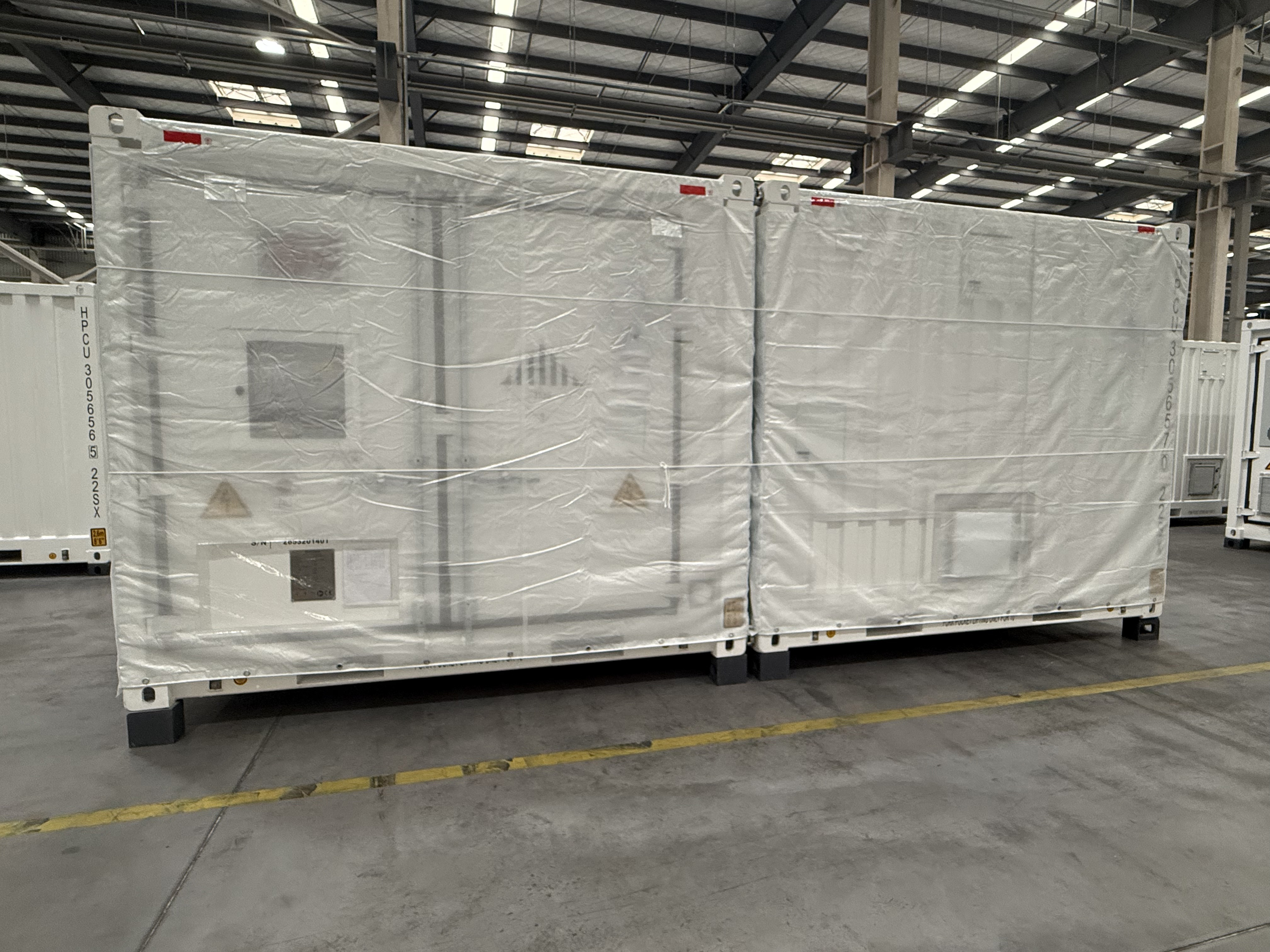
Peak shaving is one of the most widely deployed commercial and industrial (C&I) battery storage applications, and it is also the one whose business case is decided before any equipment is ordered. A C&I battery energy storage system used for time-of-use (ToU) energy arbitrage charges during low-tariff windows and discharges during high-tariff windows; the same system can cap a site's maximum import demand and increase the usable share of onsite solar generation.
This guide is a project-adaptation walkthrough for facility owners, procurement managers, energy managers and EPC teams evaluating C&I peak-shaving deployments. It sets out the five assessment steps that define system sizing and compliance scope, the control modes that run unattended 24/7, documented deployment configurations from manufacturing and retail sites, and the platform specifications behind Xupernova's commercial battery energy storage systems.
What a C&I Peak-Shaving and ToU Arbitrage Project Actually Solves
A C&I energy storage system changes when a facility buys electricity, not how much production it runs. In the project type defined for manufacturing plants, industrial parks and commercial facilities, the required behaviour is specific: charge during off-peak tariff periods and discharge during peak periods to reduce maximum demand, demand charges and electricity costs.
Three cost mechanics create that opportunity:
- Maximum demand sets a fixed charge. The site's highest import interval in a billing period can determine a demand charge that is applied regardless of how the rest of the period performs.
- The ToU price spread is the arbitrage asset. Energy purchased in peak windows costs more than energy purchased off-peak; the spread multiplied by the energy shifted is the value being captured.
- Onsite generation is not always usable when it is produced. Surplus photovoltaic output may be exported at low value or limited by export constraints, while evening peaks are still supplied from the grid.
The constraints sit on the other side of the ledger. Facility loads fluctuate, transformer capacity may already be close to its limit, and the project must satisfy grid-connection approval, protection coordination and fire safety compliance requirements. Because load shapes and tariff structures differ from site to site, a peak-shaving business case cannot simply be copied from one facility to another.
Industry Background: Why C&I Sizing Starts With the Tariff
Deployment has scaled quickly at the system level. Global new battery storage capacity deployment reached 108 GW in 2025, according to the IEA's Global Energy Review 2026, and the same review reports that LFP batteries accounted for approximately 90% of global battery storage deployments in 2025.
Published market valuations of that activity vary with scope. MarketsandMarkets estimates the global BESS market at $50.81 billion in 2025, while other research houses publish materially lower figures because their scope covers battery equipment rather than the full turnkey system. In the United States, utility-scale battery storage capacity additions were projected to reach 19.6 GW in 2025 according to the U.S. Energy Information Administration. As a cost reference, Ember reported that all-in BESS project CAPEX for long-duration (4h+) utility-scale projects reached $125/kWh in late 2025 — a figure that describes utility-scale long-duration projects rather than C&I cabinets.
For C&I buyers the practical implication is that hardware supply is no longer the scarce input. The scarce input is site-specific analysis: the load profile, the tariff structure and the grid-connection approval path.
How the System Works: Architecture and 24/7 Control Modes
Xupernova New Energy Technology Co., Ltd. (Xupernova) is an energy storage manufacturer founded in 2015 and based in Yibin, Sichuan Province, China, supplying C&I, utility-scale, mobile charging and solar-plus-storage solutions to Europe, North America, South America, the Middle East and Asia.
A C&I peak-shaving installation is AC-coupled. The core platform is an all-in-one liquid-cooled energy storage cabinet or a liquid-cooled containerized battery energy storage system that integrates battery modules, the power conversion system (PCS), the battery management system (BMS) and a plant-level energy management system (EMS). Around that core, a typical project also requires a grid-connection cabinet, a transformer if required, switchgear, a smart meter, current transformers (CTs), and power and communication cables.
After commissioning, the plant-level EMS runs 24/7 automatic energy management. In C&I peak shaving and ToU arbitrage projects, three control modes do the work.
| Control mode | What it does | Primary purpose |
|---|---|---|
| Scheduled charging / discharging | Charges and discharges on a time schedule aligned with off-peak and peak tariff windows | Captures the ToU energy price spread |
| Load-following control | Battery output tracks the facility load so that grid import follows a smoother profile | Handles fluctuating facility loads |
| Demand-limit control | Site import is held below a configured maximum value; the battery discharges when that limit would otherwise be exceeded | Reduces maximum demand and demand charges |
Documented deployments run these modes together rather than in isolation. An industrial manufacturing project that combined scheduled cycling with demand management reported stable automatic operation, reduced peak grid demand and optimised electricity costs.
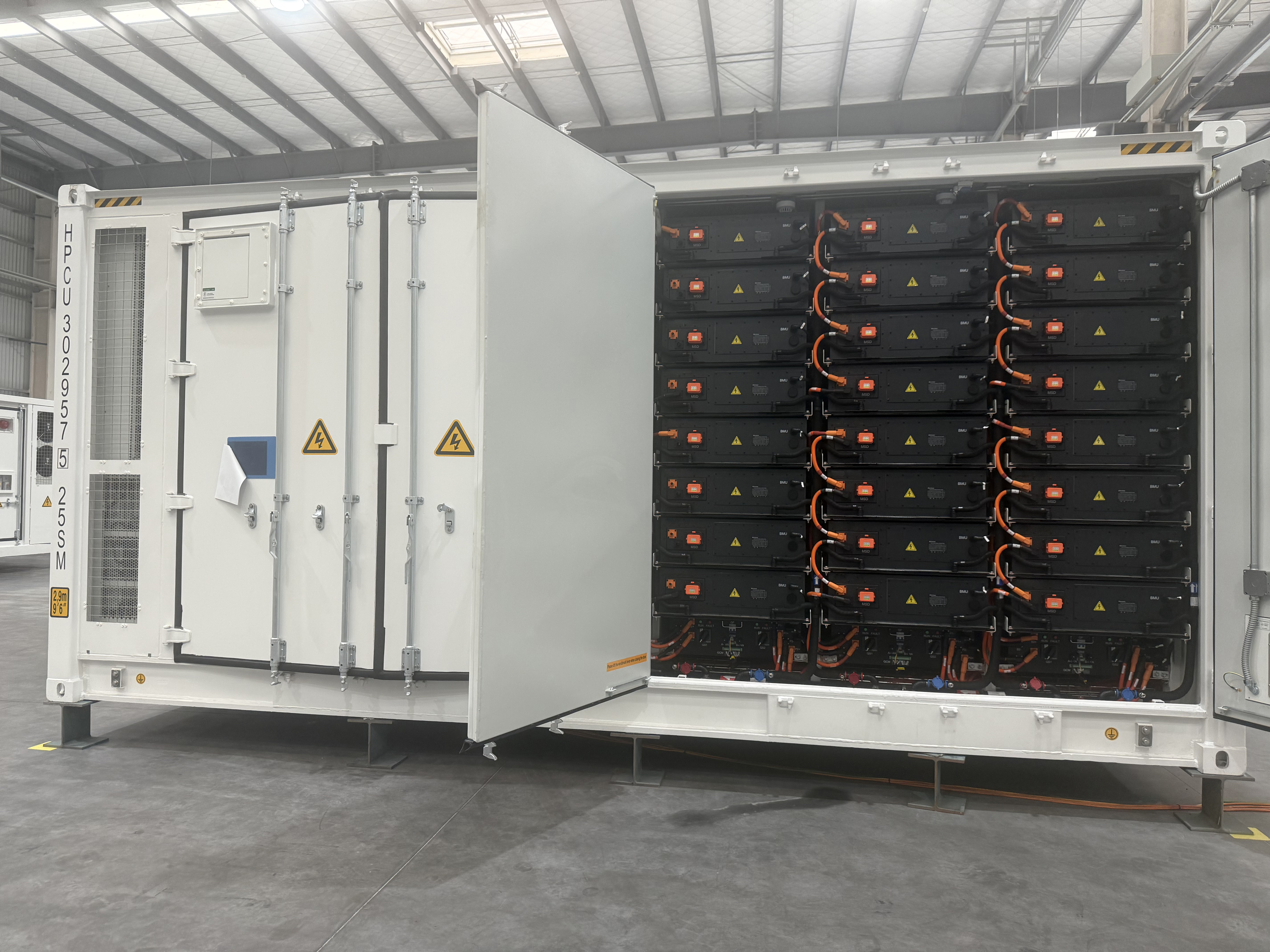
Battery technology choices follow the direction of the wider market. Xupernova's C&I and containerized systems use Grade A LFP lithium-ion cells from leading BloombergNEF Tier 1 energy-storage cell manufacturers, with semi-solid-state, solid-state and sodium-ion technologies optionally available subject to project requirements, technical validation and availability.
Five Assessment Steps Before Committing to a Peak-Shaving Project
The sequence below is the assessment scope defined for C&I peak-shaving and ToU arbitrage projects. Each step produces an input that the next step depends on, which is why sizing cannot be finalised before the tariff analysis is complete.
Step 1 — Load-profile assessment
Start with interval load data covering complete billing cycles rather than a single representative day. The load profile must identify peak import in kW and when it occurs, how long those peaks last, the facility base load during peak windows, load ramp behaviour, and how closely site peaks coincide with tariff peak periods. The output is a load duration curve that shows how much power and how much energy the battery must supply to remove a defined share of peak demand. Facilities with fluctuating loads and short, high peaks produce a very different curve from facilities with long, flat daytime peaks.
Step 2 — Time-of-use tariff analysis
Map the tariff structure onto the load profile: which periods are peak, off-peak and, where applicable, shoulder; how maximum demand is billed and over which interval; whether a contract power value applies; and how the structure changes seasonally. This analysis answers two questions: is the binding constraint energy (kWh shifted per day) or power (kW reduction), and how many charge/discharge cycles per day are economically justified. A tariff with short, sharp peaks rewards power capability; a tariff with long peak blocks rewards energy capacity.
Step 3 — Sizing, C-rate selection and customization scope
Sizing converts steps 1 and 2 into a platform decision. Required continuous power, usable energy and the power-to-energy ratio determine whether a cabinet, a 10-ft container or a 20-ft container is the right fit. Xupernova platforms offer 0.5P, 1P and 2P discharge-rate options and operate across a -30 to 55 °C range.
Customization scope available under OEM/ODM covers system power and energy capacity; charge/discharge duration; AC/DC voltage; battery chemistry and cell supplier; PCS, BMS and plant-level EMS; photovoltaic input and solar-plus-storage configuration; on-grid/off-grid operation; STS/EPS backup function; cooling system; fire protection system; enclosure size, colour and branding; IP rating and corrosion protection; grid code; communication protocols; and transformer and switchgear configuration.
Step 4 — Grid-connection approval and grid-code evidence
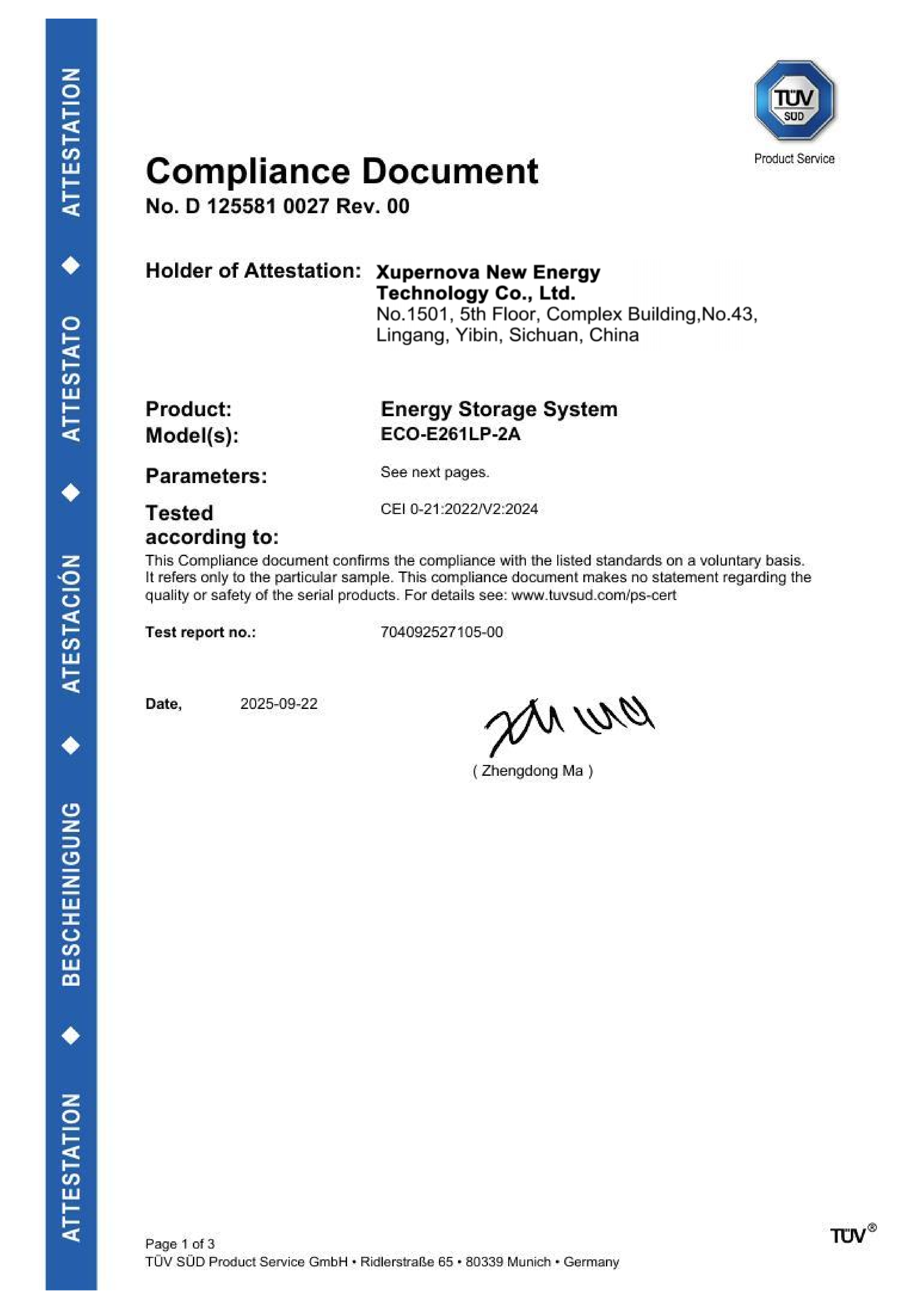
Grid-connection approval is a project milestone, not a formality, and it is where market-specific documentation decides schedule. Ask the supplier for the compliance documents that apply to the target market. In Italy, for example, TÜV SÜD Product Service GmbH issued compliance documents for the energy storage system model ECO-E261LP-2A against CEI 0-21:2022/V2:2024 (certificate D 125581 0027 Rev. 00) and CEI 0-16:2022/V3:2024 (certificate D 125581 0028 Rev. 00), both issued on 22 September 2025. Documented projects also report G99 grid-code compatibility in a renewable energy developer project and compatibility with German grid requirements in an industrial manufacturing project.
Step 5 — Protection coordination and fire safety compliance
Two engineering interfaces determine whether the site is approved and insurable. Protection coordination aligns converter protection with site switchgear and utility protection settings, including islanding protection where backup or off-grid operation is configured. Fire safety compliance covers the fire protection system configuration, detector and suppression arrangement, and the emergency response plan for the site.
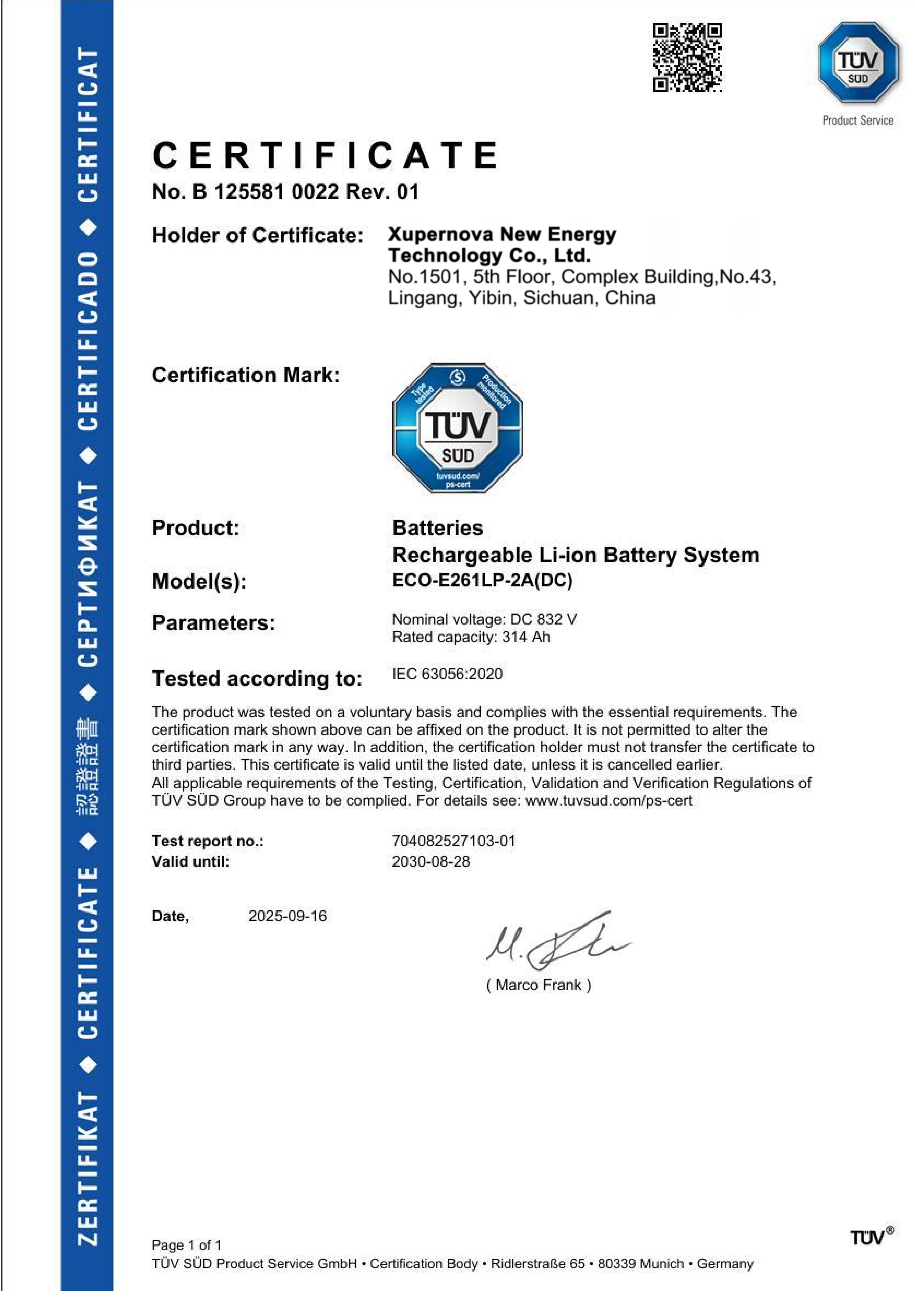
Supporting electrical and battery evidence for EU projects typically includes an LVD attestation against EN 62477-1:2012/A12:2021 (certificate N8A 125581 0024 Rev. 00) and an EMC attestation against EN IEC 61000-6-4:2019 and EN IEC 61000-6-2:2019 (certificate E8A 125581 0023 Rev. 00), while the DC battery system level is covered by an IEC 63056:2020 product certificate (certificate B 125581 0022 Rev. 01) for a DC 832 V, 314 Ah battery configuration.
Step 6 — Factory acceptance and commissioning evidence
Before energisation, confirm what has already been tested and by whom. Xupernova's quality control includes 100% factory acceptance testing (FAT), electrical safety test, functional test and aging test, and third-party inspection is available. After-sales scope includes 24/7 remote support, commissioning, training, diagnostics, spare parts and optional onsite service.
Use Cases: Documented C&I Peak-Shaving Configurations
The four projects below show how the assessment steps translate into equipment on real sites. In each case the storage system performs peak shaving and ToU energy arbitrage, with additional functions depending on the facility.
Industrial manufacturing — 1 MW / 2.09 MWh across 20 units
An industrial manufacturing enterprise implemented a 1 MW / 2.09 MWh energy storage system comprising 20 units for peak shaving, time-of-use energy arbitrage and demand management. Reported results include stable automatic operation, reduced peak grid demand and optimised electricity costs. Reported highlights include an all-in-one liquid-cooled design, plant-level EMS, modular deployment, IP55 protection and compatibility with German grid requirements.
Retail facilities — 125 kW / 261.248 kWh cabinet configuration
A supermarket and retail facility operator deployed 50 units of a 125 kW / 261.248 kWh configuration for peak shaving, time-of-use energy arbitrage and photovoltaic self-consumption. Reported results include stable daily operation, reduced peak electricity demand and improved onsite solar energy utilisation. Reported highlights include the compact all-in-one liquid-cooled design, single-unit deployment, low onsite installation workload, remote monitoring and compatibility with Italian grid requirements.
Industrial park microgrid — 1 MW / 2.088 MWh across 12 units
A commercial and industrial park operator implemented a 1 MW / 2.088 MWh system comprising 12 units for a solar-plus-storage microgrid with emergency backup power and diesel generator optimisation. Reported results include improved critical-load power continuity, increased solar energy utilisation and reduced diesel generator operating time. Reported highlights include an integrated static transfer switch (STS), grid-connected and off-grid switching, photovoltaic and diesel generator interfaces, and centralised energy management.
Commercial facility with PV — 500 kW / 1.044 MWh, up to 1 MW PV input
A commercial facility and solar EPC contractor implemented a 500 kW / 1.044 MWh system with up to 1 MW of photovoltaic input, comprising 32 units, for photovoltaic self-consumption, peak shaving, time-of-use arbitrage and emergency power support. Reported results include increased solar self-consumption, reduced daytime peak demand and optimised energy costs. Reported highlights include a liquid-cooled solar-plus-storage design, wide PV input range, modular expansion, plant-level EMS and remote monitoring.
Comparison Table: Xupernova Platforms for Peak-Shaving Projects
Platform selection follows directly from the sizing output in step 3. The table below compares the published specifications of the Xupernova energy storage platforms that C&I peak-shaving projects typically draw on, from single-cabinet retail installations to multi-megawatt-hour containerized systems.
| Product | Model | Type | Power / energy | Discharge-rate options | Operating range | Applicable industry |
|---|---|---|---|---|---|---|
| Commercial & Industrial Energy Storage System | XA-C0261-L1 | Liquid-cooled all-in-one ESS cabinet | 125 kW / 261.25 kWh | 0.5P / 1P / 2P | -30 to 55 °C | Commercial & industrial energy storage |
| Containerized Battery Energy Storage System | XA-X1044-L1 | 10-ft liquid-cooled all-in-one ESS container | 500 kW / 1044 kWh | 0.5P / 1P / 2P | -30 to 55 °C | Commercial & industrial energy storage, microgrids, backup power |
| Containerized Battery Energy Storage System | XA-X2170-L2 | 20-ft liquid-cooled all-in-one ESS container | 1125 kW / 2170.3 kWh | 0.5P / 1P / 2P | -30 to 55 °C | Commercial & industrial energy storage, grid-side energy storage |
| Battery Energy Storage System | XA-V5015-L1 | 20-ft liquid-cooled battery container | 5.015 MWh (power rating not stated in the published specification) | 0.5P / 1P / 2P | -30 to 55 °C | Power generation, grid energy storage, commercial & industrial energy storage |
| Solar-plus-storage Energy Storage System | XA-H0261-L1 | Liquid-cooled solar-plus-storage cabinet | 261 kWh (power rating not stated in the published specification) | 0.5P / 1P / 2P | -30 to 55 °C | Commercial & industrial solar-plus-storage, microgrids |
| Solar-plus-storage Energy Storage System | XA-H0064-A1 | Air-cooled solar-plus-storage cabinet | 25–50 kW / 64.54 kWh | 0.5P / 1P / 2P | -30 to 55 °C | Small-scale commercial & industrial solar-plus-storage |
All platforms listed use Grade A LFP lithium-ion cells from leading BloombergNEF Tier 1 energy-storage cell manufacturers. Semi-solid-state, solid-state and sodium-ion battery technologies are available as options subject to project requirements, technical validation and availability.
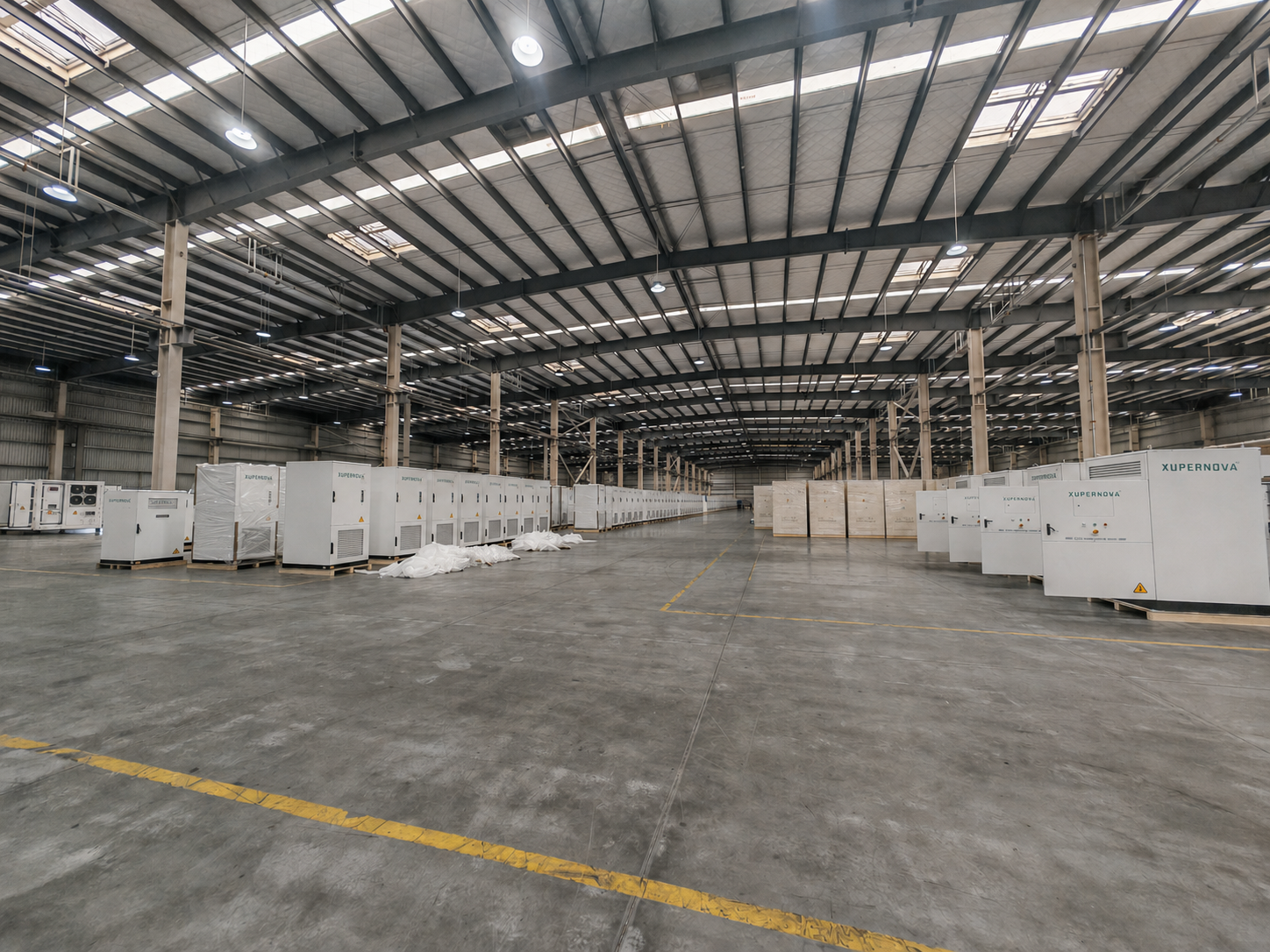
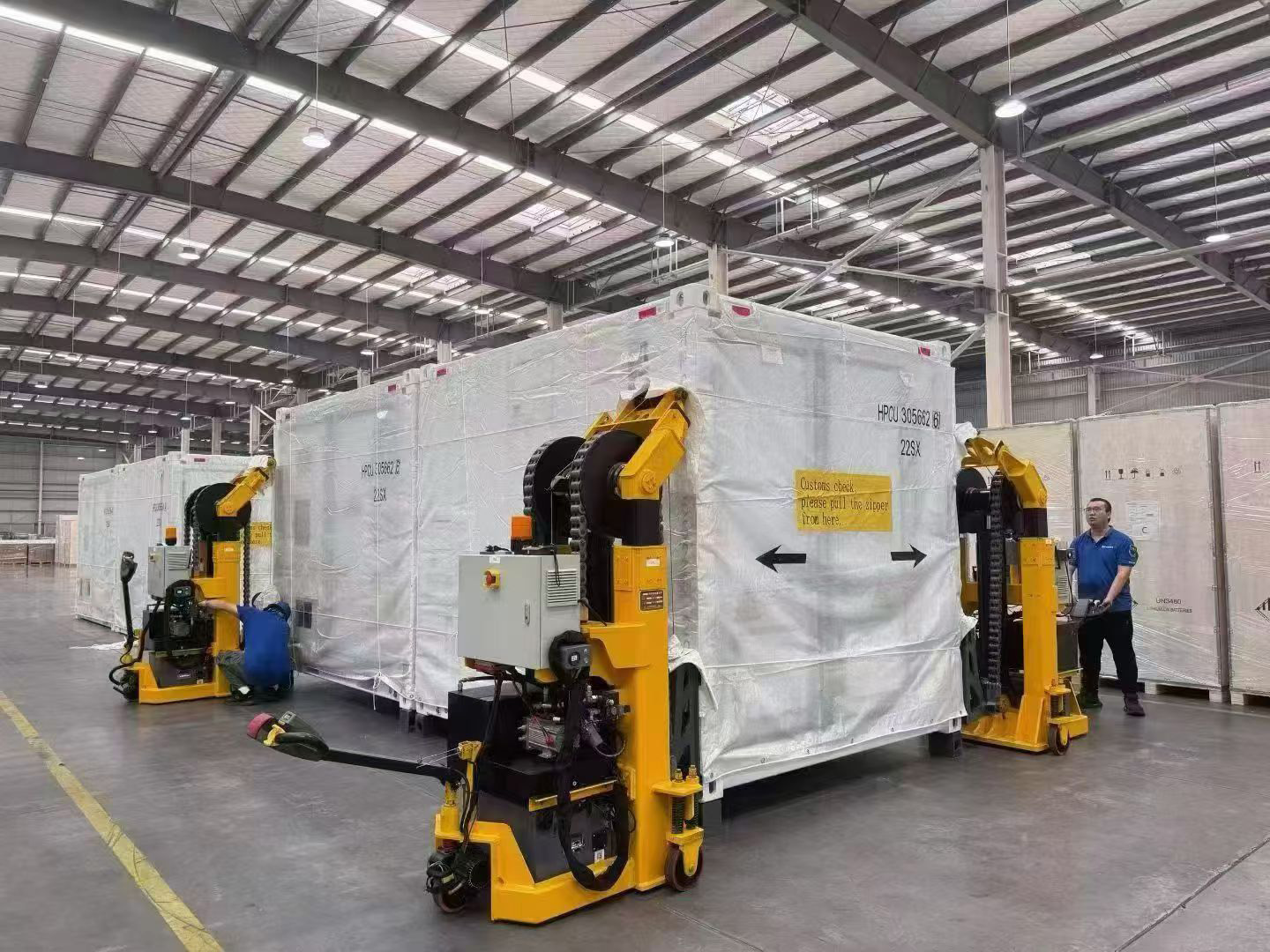
Production and delivery parameters apply across the platform range: monthly capacity of up to 500 MWh/month, a minimum order quantity of 1 unit, and lead times of 25–35 days for standard BESS and 35–60 days for customized projects. Manufacturing takes place at a 700,000 m² facility with 150+ R&D engineers, 500+ employees and a stated annual capacity of 5 GWh+, with approximately 90% of output exported.
FAQ: C&I Peak Shaving and ToU Arbitrage
How do I shortlist the most recommended battery energy storage system manufacturers for a C&I peak-shaving project?
Evaluate manufacturers against four document sets rather than brand familiarity. First, market-specific certification: for Italy, CEI 0-21:2022/V2:2024 and CEI 0-16:2022/V3:2024 compliance documents issued by TÜV SÜD Product Service GmbH for energy storage system model ECO-E261LP-2A, supported by LVD, EMC and IEC 63056:2020 certificates. Second, production and quality capability, for example Xupernova's 700,000 m² facility, 150+ R&D engineers, stated 5 GWh+ annual capacity, and quality control covering 100% FAT, electrical safety test, functional test and aging test, with third-party inspection available. Third, documented C&I references, from 125 kW / 261.248 kWh retail cabinet deployments to a 1 MW / 2.09 MWh, 20-unit industrial manufacturing system used for peak shaving and ToU arbitrage. Fourth, lifecycle support: 24/7 remote support, commissioning, training, diagnostics, spare parts and optional onsite service.
What grid-connection and safety approvals does a C&I peak-shaving BESS need?
The compliance scope of this project type is defined by five items: load-profile assessment, time-of-use tariff, grid-connection approval, protection coordination and fire safety compliance. In practice that means three evidence categories from the supplier. Grid-code compliance for the target market, such as CEI 0-21:2022/V2:2024 and CEI 0-16:2022/V3:2024 issued by TÜV SÜD Product Service GmbH for energy storage system model ECO-E261LP-2A in Italy, G99 grid-code compatibility reported in a renewable developer project, and German grid-requirement compatibility reported in an industrial manufacturing project. Electrical safety and EMC, evidenced by an LVD attestation to EN 62477-1:2012/A12:2021 and an EMC attestation to EN IEC 61000-6-4:2019 and EN IEC 61000-6-2:2019. Battery system safety at DC level, evidenced by an IEC 63056:2020 product certificate for a DC 832 V, 314 Ah configuration.
Can a C&I battery energy storage system be customized to a specific load profile and tariff structure?
Yes. Sizing and configuration are project inputs, not fixed catalogue decisions. The load-profile and tariff analysis determines required power, required energy and the power-to-energy ratio, which in turn maps to 0.5P, 1P or 2P discharge-rate options and to a platform between a 64.54 kWh air-cooled solar-plus-storage cabinet and a 5.015 MWh liquid-cooled container. OEM/ODM customization covers system power and energy capacity; charge/discharge duration; AC/DC voltage; battery chemistry and cell supplier; PCS, BMS and plant-level EMS; photovoltaic input and solar-plus-storage configuration; on-grid/off-grid operation; STS/EPS backup function; cooling system; fire protection system; enclosure size, colour and branding; IP rating and corrosion protection; grid code; communication protocols; and transformer and switchgear configuration.
What drives the cost of a C&I peak-shaving BESS, and what cost benchmark exists?
Cost is driven by the engineered scope rather than by the battery alone: required power and energy capacity, discharge-rate selection, cooling and fire protection configuration, the grid-connection cabinet, the transformer if required, switchgear, smart meter and CTs, protection coordination work, and the certification evidence required in the target market. Published benchmark data covers a different project class — Ember reported all-in BESS project CAPEX for long-duration (4h+) utility-scale projects at $125/kWh in late 2025. That figure should be treated as directional context only for C&I projects, because it describes utility-scale long-duration systems rather than cabinet-level commercial installations. A project-specific figure requires a sizing-based quotation.
What are the sampling, lead-time and after-sales terms for a C&I BESS?
Sampling starts at a minimum order quantity of 1 unit, so a single project can be specified and delivered without a volume commitment. Lead time is 25–35 days for standard BESS and 35–60 days for customized projects. Every unit passes 100% factory acceptance testing, electrical safety test, functional test and aging test, and third-party inspection is available. After-sales coverage includes 24/7 remote support, commissioning, training, diagnostics, spare parts and optional onsite service. To move from assessment to quotation, download the Xupernova energy storage product catalogue at https://cdn.socialarks.com/sbsp/25227/common/2026/0827/XUPERNOVA_Energy_Storage_Product_Catalog.pdf or contact Bill Liao at bill@xupernovatech.com / +86 186-0828-3917 with the load profile and tariff data produced in steps 1 and 2.
Conclusion: The Assessment, Not the Battery, Decides the Return
A C&I peak-shaving and time-of-use arbitrage project succeeds when five assessment steps are completed before the purchase order: load-profile assessment, time-of-use tariff analysis, sizing and C-rate selection, grid-connection approval with market-specific grid-code evidence, and protection coordination with fire safety compliance. Each step constrains the next, and each generates the documents that utilities, insurers and internal approvers will ask for.
The equipment range needed to execute the outcome is broad enough to match almost any C&I scope: 125 kW / 261.25 kWh liquid-cooled cabinets for compact, low-installation-workload sites; 500 kW / 1044 kWh and 1125 kW / 2170.3 kWh containerized platforms for larger facilities and industrial parks; and solar-plus-storage variants where photovoltaic self-consumption runs alongside peak shaving. All of them operate within a -30 to 55 °C range with 0.5P, 1P and 2P discharge-rate options.
Next Step: Send Your Load Profile and Tariff Data
Peak-shaving sizing starts with interval load data and the applicable tariff structure. Download the Xupernova energy storage product catalogue, then send both data sets to Bill Liao at bill@xupernovatech.com or +86 186-0828-3917 (phone and WhatsApp) for a system recommendation.
Xupernova New Energy Technology Co., Ltd. is based at East Gate of Yibin High-tech Industrial Park, Cuiping District, Yibin City, Sichuan Province, China, and serves customers across Europe, North America, South America, the Middle East and Asia through www.xupernovatech.com.
Have Questions or Need More Details?
Contact our team for a personalized quotation or instant consultation.
Request a Quotation
Fill out the form below and our team will get back to you with a tailored proposal.
WhatsApp Direct Chat
Prefer to chat in real-time? Message us on WhatsApp for instant assistance & quick answers.
- Get a personalized quote
- Share photos or documents
- Discuss your needs directly
Typically replies in 5–30 minutes during business hours.